 OK, we gotta talk business for a while, bear with me, 'cuz y'all are an integral part of the path to ultimate success for our boys. Readers who come here obviously care deeply about the music and the future success of Santa Fe and The Fat City Horns. I posted back in January about a great book on the topic of the business aspects of music - see The "Future of Music by Dave Kusek and Gerd Leonhard. Ya really oughta buy a copy.
 As I listen to the Santa Fe CD -- over and over and over and over and over... -- and Phil Wigfall's absolutely ass-kicking solo CD, and the works of Jerry's friends the Petersons, as I repeatedly go witness the guys throw down with the stunning Ronnie Foster, as I hope for steady gigs and success for Brother Lenny's new band Ritmo, etc., I keep thinking back to the insights provided in this book, along with all of the business financial and statistical modeling stuff I've learned since going White Collar after hanging up my axe 20 years ago (weary of schlepping crap gigs for fifty bucks a night. Not a lot has changed in the ensuing 20 years). So, I'm just gonna rant for a bit here, and I welcome any feedback.
Let's think about the online sales venue CD Baby for a sec. As of today, they tout the following:
- 131,959 artists sell their CD at CD Baby.
- 2,322,378 CDs sold online to customers.
- $26,769,371.77 paid to artists.
In the traditional record business model, you turn over the marketing of your music (and, typically, the copyrights in perpetuity) to people who overwhelmingly don't give a shit about you -- you're just one more "product" in their account workload, and if you fail to catch fire pronto, well, you are toast (but we'll retain ownership of your copyrights, thank you).
Kusek and Leonhard, however, argue that we are returning to a music business model increasingly based on direct artist-to-audience long-term relationships. A fashionable buzzword here is "Viral Marketing." All of which got me thinking about the applicability of a math example I've often used on my students in my "Critical thinking" classes, to get them thinking about some of the ways in which numbers can be misleading (the core principle of our Nevada economy, haha!). Assume, then, betting just one dollar on a sports event. If your team or player loses, you double your bet. If there's yet another loss, you double your bet again. And, so on until he/she/they eventually win and you recoup and finally win some money...
OK, consider the following tabulation. What lengths of losing streaks could your wallet withstand?
| Loss | Bet | Cumulative bet |
| 0 | $1 | $1 |
| 1 | $2 | $3 |
| 2 | $4 | $7 |
| 3 | $8 | $15 |
| 4 | $16 | $31 |
| 5 | $32 | $63 |
| 6 | $64 | $127 |
| 7 | $128 | $255 |
| 8 | $256 | $511 |
| 9 | $512 | $1,023 |
| 10 | $1,024 | $2,047 |
| 11 | $2,048 | $4,095 |
| 12 | $4,096 | $8,191 |
| 13 | $8,192 | $16,383 |
| 14 | $16,384 | $32,767 |
| 15 | $32,768 | $65,535 |
| 16 | $65,536 | $131,071 |
| 17 | $131,072 | $262,143 |
| 18 | $262,144 | $524,287 |
| 19 | $524,288 | $1,048,575 |
| 20 | $1,048,576 | $2,097,151 |
Had you started this way betting on the 1976 NFL Tampa Bay Bucs -- initially betting simply $1 -- you'd have been out $32,767 by the end of their 0-14 season if you'd stayed with your plan (assuming you had that much dough to fritter away). How about the hapless 1972-73 NBA 76'ers, who endured, in that one season, losing streaks of 13, 14, 15, and 20 games. Probably bankrupted a bunch of gamblers in the process.
The flip side
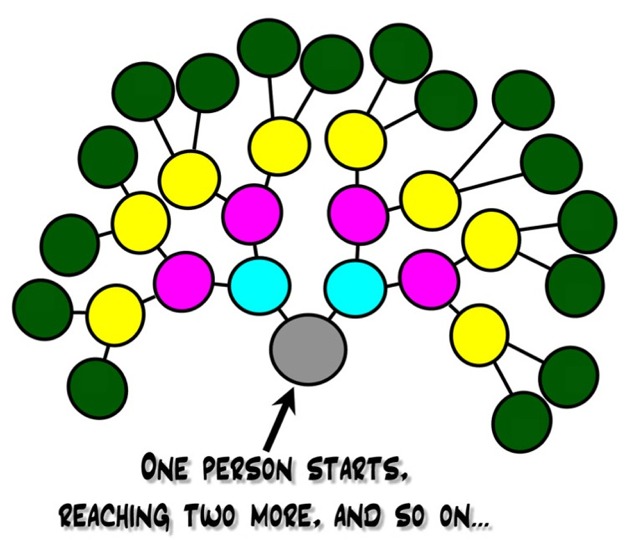
"Each one reach two." Pay it forward. The reverse of the betting loss scenario, under the same exponential math principle. What would likely happen if each of us Santa Fe crazies spread the love and healing to just two people (I know this is already happening ad hoc), and each of those two did likewise, and so on and so on, and kept it going...? Well, I put some stuff in a spreadsheet, and then saved it as a web page here (I hope you can view it, let me know). There are 3 tabs. The tab labeled "Exponential sales" displays a scenario that assumes [1] each of us reaches two others in turn, and [2] of those, let's say -- conservatively -- 10% of those reached overall will buy Santa Fe product, and that [3] the blended CD + DVD price of units bought is $35 (discounted from the $20 + $30 full price). Under this model, 20 iterations of "each reach two" would get us to $7.3 million in gross sales. (Now, you can fiddle with my numbers to your hearts' content by just downloading the Excel spreadsheet here. Change the gross unit price, change the % expected to buy, -- change the "each one reach" to 3 and see what happens. Pretty amazing.)
The question then becomes: how do we share the wealth with those doing the person-to-person viral marketing for the band so that [1] they can just work on their awesome music full-time (which is what we all dream about them getting to do), and [2] not have to sell their souls to some corporate entity that would put their financial interests dead last (which our guys would never do anyway)? Some of us (uh, yours truly) will evangelize this band with no incentive other than our own admiration for what they continue to pull off, going totally against the economic grain. But, in general, those who help make an artist a success ought share in that success. People respond to incentives. I'm open to suggestion.**
UPDATE: Here's a simple scenario. Assume '"each one reaches two" on average, and of those two in turn -- again, on average -- you get one CD sale per iteration (ignoring the DVD for the moment for simplicity), so the "expected value" (probability times the payoff) is 50% x $20, or $10 per contact.
| Iteration | N, each iteration | Cumulative N | Potential buyers | Expected sales, cumulative |
| 0 | 1 | 1 | 1 | $ 10 |
| 1 | 2 | 3 | 2 | $ 30 |
| 2 | 4 | 7 | 4 | $ 70 |
| 3 | 8 | 15 | 8 | $ 150 |
| 4 | 16 | 31 | 16 | $ 310 |
| 5 | 32 | 63 | 32 | $ 630 |
| 6 | 64 | 127 | 64 | $ 1,270 |
| 7 | 128 | 255 | 128 | $ 2,550 |
| 8 | 256 | 511 | 256 | $ 5,110 |
| 9 | 512 | 1,023 | 512 | $ 10,230 |
| 10 | 1,024 | 2,047 | 1,024 | $ 20,470 |
| 11 | 2,048 | 4,095 | 2,048 | $ 40,950 |
| 12 | 4,096 | 8,191 | 4,096 | $ 81,910 |
| 13 | 8,192 | 16,383 | 8,192 | $ 163,830 |
| 14 | 16,384 | 32,767 | 16,384 | $ 327,670 |
| 15 | 32,768 | 65,535 | 32,768 | $ 655,350 |
| 16 | 65,536 | 131,071 | 65,536 | $ 1,310,710 |
| 17 | 131,072 | 262,143 | 131,072 | $ 2,621,430 |
| 18 | 262,144 | 524,287 | 262,144 | $ 5,242,870 |
| 19 | 524,288 | 1,048,575 | 524,288 | $ 10,485,750 |
| 20 | 1,048,576 | 2,097,151 | 1,048,576 | $ 20,971,510 |
| 21 | 2,097,152 | 4,194,303 | 2,097,152 | $ 41,943,030 |
| 22 | 4,194,304 | 8,388,607 | 4,194,304 | $ 83,886,070 |
| 23 | 8,388,608 | 16,777,215 | 8,388,608 | $ 167,772,150 |
| 24 | 16,777,216 | 33,554,431 | 16,777,216 | $ 335,544,310 |
Twenty iterations of "each one reach two" at a 50% expectation gets you to a million units sold, grossing ~$21 million. How do we directly compensate those (the fans) who could make this happen without the usual costly intermediaries such as record labels, distributors, bricks & mortar stores -- and their online counterparts? Ask yourself, do you know two potential devoted Santa Fe Fans who each have two friends with the same tastes and appreciation for excellence? (hell, I can think of twenty right off the bat) Now, in the conventional record label model, the Suits and their supply chain middlemen would take nearly all of that $21 million. In fact, you might end up owing the label money even after selling a million+ units. Happens all the time. There's gotta be a better, workable, and just way. The potential worldwide market for Santa Fe and The Fat City Horns is huge.
I don't pretend to have the answers (just yet). But I think about this stuff all the time. I would love to see this band tour the world to spread their stunning music and healing goodness far and wide.
Together, we might just help make it happen.
_____
** some of you might recognize one mechanism here as akin to that of "Multi-level Marketing." But, in that model (and its unethical and illegal cousin the Pyramid scheme), those who get in early make big money off those getting in later (called the "downline," where you ostensibly get of cut of the revenue generated by everyone you bring in, and everyone they bring in, in turn all the way "down the line"), with the last to get in making nothing at all (and maybe losing their asses). That's not what I'm envisioning. I'm trying to come up with a viable business model that is a win-win, one that greases the considerable financial and logistical skids for Santa Fe to be a worldwide success (and selling physical product will continue to be a big part of that). What the guys do is a rare and precious phenomenon. I don't want to see it end any time soon. I'm sure y'all are with me in that sentiment.
_____
MONDAY MORNING OFF-TOPIC UPDATE: I just had the deliriously cool pleasure of again running several hours of full-court hoops with jazz pianist par exellance Ronnie Foster, yesterday at 24 Hour Fitness Sport at W. Sahara & Buffalo. I have never been around a more consistently pleasant and genuinely friendly man. Ronnie seems to know everyone in the gym, from the young kids to the old school dudes, and he exudes such happiness and good will that I have to wonder whether it's a reason that, when we're together on the court, I never seem to see/hear the usual trash-talking and angry arguing that is so irritatingly common in pickup ball. A great role model. Bro', I salute you.
Please do go hang at The Artisan on Thursdays and Saturdays starting at 10pm to hear Ronnie and the guys burn it up. Props to Drew Zingg for the fine guitar subbing for Jerry last Saturday, and also to Etsuko Mader, again filling in excellently for Jamie Hosmer.


